


Ford Duratec 2.0 HP Profile kit
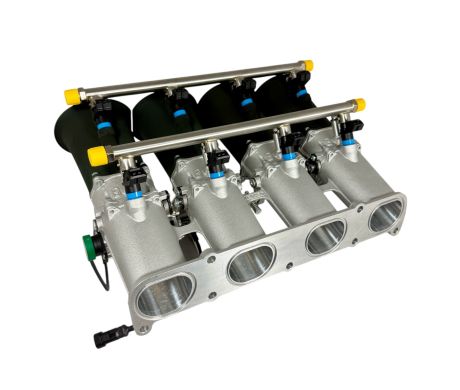
Engineered for precision, performance and reliability, the all new Jenvey Ford Duratec Profile Butterfly Kit sets a new benchmark for naturally aspirated throttle technology. Designed and manufactured in the UK, this advanced induction system delivers exceptional throttle response, improved airflow, and uncompromising power for both road and race applications.
This kit also suits the Power Torque Dura-Power engines.
Kit performance is enhanced by careful positioning of the EFI fuel injectors being located further upstream than standard and directly in the part throttle turbulence of the butterfly. This allows increased time/distance for improved fuel mixing increasing torque and power where its needed. Our spindles profiled to minimise cross sectional area at full throttle and an 8 degree shut angle (shallower than most) gives finer control at small throttle openings. Our kits come built and balanced ready to fit you your engine and win races.
Jenvey Dynamics design, develop and manufacture all products in house often working with leading engine builders. Uniquely, with our own foundry, all castings are created in the same factory that they are machined and built in. Our cast systems are significantly lighter than fully CNC parts and all major components are backed up by rig tests of over 1 million cycles. All our standard kits are proven but our throttle systems are extremely modular allowing bespoke throttle sizes and system lengths. Please order components individually for bespoke application.
CKFD29 - Base kit only. No linkage included
CKFD29-CLS - Base kit with cable actuation
CKFD29-ETA2 - Base kit with electronic throttle
Frequently Asked Questions
What port shape does this system fit?
There are two versions available:
- Standard Ginetta G20 cylinder head port shape
- CNC port shape developed by Ultimate Performance Ltd (UK)
What is the equivalent butterfly size?
The throttle butterfly size is approximately equivalent to a 54mm round throttle body.
What RPM range is the system optimised for?
The original system length was developed on the Jenvey Gunn 2.0L engine, producing 320hp with a maximum engine speed of 9,200rpm. For maximum race performance at 9,500rpm, we now use a slightly shorter intake system.
Why not run barrels with no throttle obstruction?
Where packaging allows, unobstructed barrels can be beneficial. However, butterflies provide excellent part throttle drivability and fuel air mixing, while creating minimal airflow obstruction at full throttle. Even in high performance applications, butterflies often provide the best compromise between drivability and peak power.
Aren't profile butterfly systems usually heavy?
No. The base kit weighs approximately 2kg, with the electronic throttle actuator adding around 500g.
Why are there two sets of injectors?
The primary injectors are positioned in the throttle bodies, just downstream of the butterflies, where turbulence helps mix fuel and air at lower engine speeds and part throttle.
A second set of injectors is mounted in the air horns for high RPM operation. Testing showed the air horn injectors can add 6–7hp at high engine speeds. These secondary injectors typically operate above 4,000rpm and 60% throttle.
Where should I run the TPS on the electronic throttle version?
There is no dedicated throttle position sensor (TPS) mounting location on the butterflies themselves. A sensor can be mounted on the layshaft for cable throttle applications.
For electronic throttle systems, it is common to use TPS signals from both the layshaft and the electronic actuator. On our development vehicle running an MBE 9A9 ECU, we found the best results using a dual-output sensor mounted on the electronic actuator.
What should I do with the original Duratec injector positions?
On our development engine, the original injector ports are blocked using RIPP03 injector bungs.